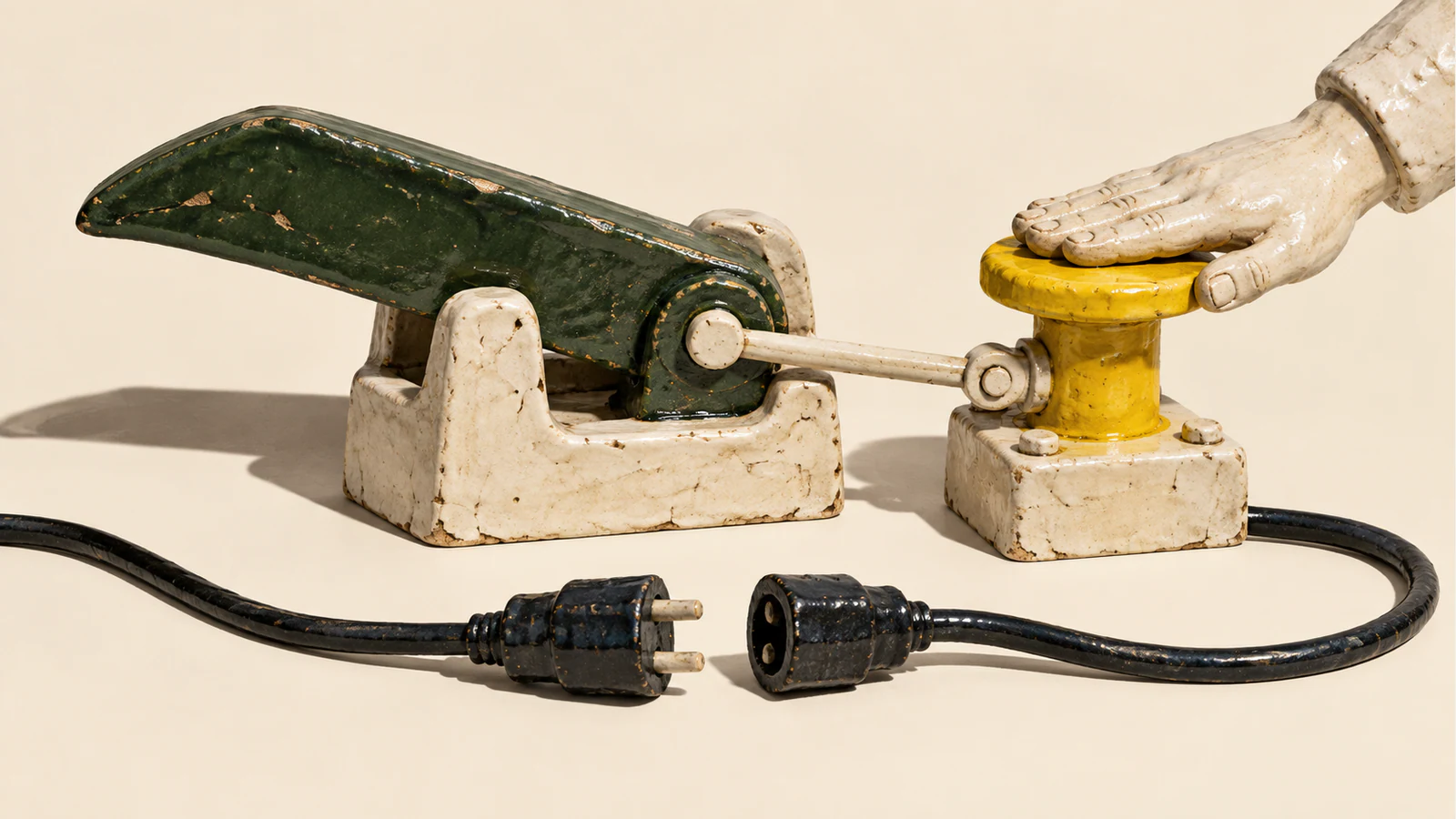
On November 12, 2026, Anthropic’s updated Usage Policy takes effect, and for any team connecting Claude to hardware that takes autonomous physical actions, it converts two safety properties into contract terms. According to Anthropic’s October 8 announcement, “A qualified operator must be able to observe the equipment and stop it if needed,” and “the equipment must also be able to hold a safe state if Claude is disconnected.” If your robotics cell, industrial automation line, or embedded product sends Claude’s outputs to actuators, your control architecture is now a compliance artifact, and you have roughly five weeks to make it one.
That is the practical finding: the policy no longer asks only what the model may say or do. It asks what your machine does when the model is wrong, unreachable, or gone. The sections below map each clause to a concrete engineering artifact, flag what the previewed text leaves undefined, and set Anthropic’s floor against regulatory and industrial practice, with the evidence limits stated plainly.
What changed on October 8
The vendor text ties the new requirements directly to Anthropic’s hardware program: “Following the launch of our Model Hardware Standard, this section also adds requirements for the use of our models when they’re connected to hardware that takes autonomous physical actions and which might be capable of causing injury” (Anthropic). The scope limit matters as much as the requirement. These clauses bind Claude-connected hardware that takes autonomous physical actions and might be capable of causing injury. The previewed wording reaches the use of Anthropic’s models on such equipment; it says nothing about other providers’ models on the same equipment, and nothing about machinery with no model connection. What it also does not settle is the advisory case: an integration where Claude recommends and a human actuates still connects Claude to hardware that takes autonomous physical actions, and the trigger in the previewed text is that connection, not Claude’s role in actuation. Confirm scope in the full policy before treating an advisory deployment as exempt.
Two obligations follow:
- Operator observation and stop capability. A qualified operator must be able to observe the equipment and stop it if needed.
- Disconnected fail-safe. The equipment must hold a safe state if Claude is disconnected.
A third requirement shares the section but predates it. For use cases affecting health, legal rights, finances, livelihood, or access to essential services, “we require there to be a qualified “human in the loop” (that is, someone who has the authority to review and, if necessary, change Claude’s recommendations), and for the individual affected to be told that AI was used” (Anthropic). That sentence carries two obligations, not one. The review gate is the first; the second is disclosure, a mechanism that tells the individual affected that AI was used. It is a separate artifact from the reviewer gate, and it predates the update with the rest. Anthropic says so directly: “These requirements haven’t changed with the updated version of our Usage Policy. However, users have often asked us whether a given use case has these requirements, so we’ve rewritten our High-risk Use Case Requirements section to answer that more directly.” The update rewords the section for clarity; it does not introduce either obligation. A team already running a high-risk deployment was bound before November 12.
The clock is explicit: “The updated policy takes effect on November 12.” Plan against that date, not against “sometime in November.”
The clause-to-artifact checklist
The announcement does not prescribe an architecture, so this mapping is inference from the previewed excerpt, not confirmed policy language. The hardware clauses carry the injury qualifier: they reach equipment that takes autonomous physical actions and might be capable of causing injury, and the previewed text does not extend them past that description. Treat it as a way to structure sign-off work, then validate it against the full policy and the Model Hardware Standard when you can read them.
| Policy clause | Engineering artifact | How to verify it | What the preview does not define |
|---|---|---|---|
| Operator can observe the equipment | Written observation procedure: named role, physical or instrumented line of sight, shift coverage | Walk the procedure with the actual operator roster; confirm observation works during nights, maintenance windows, and network degradation | Whether remote monitoring satisfies “observe”; what training or authority makes an operator “qualified” |
| Operator can stop the equipment | A stop path that halts actuation without model cooperation | Timed stop test from worst-case operating state; repeat with Claude mid-action | Required stop latency; whether software-only stops count |
| Equipment holds a safe state if Claude is disconnected | Disconnected-state fallback: defined safe state, detection of link loss, automatic transition | Pull the connection under load, in every operating mode, and record the resulting state | What “safe state” means per equipment class; how long the state must be held |
| Human in the loop for high-risk domains (a pre-existing requirement) | Review gate with named reviewer, authority to change Claude’s recommendations, and a decision record; plus a disclosure mechanism telling each affected individual that AI was used | Audit trail showing reviews happened and changed outcomes where needed; disclosure actually delivered | Which physical deployments count as high-risk; expected review depth |
Two things in that table deserve emphasis. First, the stop path must not depend on the model. A stop request routed through Claude is not a stop path; it is a suggestion the machine may never receive. Second, the disconnected safe state is a behavior you demonstrate, not a configuration you assert. The test is simple to describe and occasionally humbling to run: sever the link at the worst moment and watch what the machine does.
Who counts as a “qualified operator”? The preview does not say
This is the largest gap in the excerpt, and teams should not paper over it. The phrase appears in two clauses carrying real weight, yet the previewed text offers no definition: no training requirement, no proximity requirement, no statement about whether one operator can cover multiple cells, and no word on whether a remote dashboard satisfies “observe the equipment.”
Until the full policy or the Model Hardware Standard defines the term, I would document the conservative reading: a named person, with a defined line of sight to the equipment, with stop authority they have actually exercised. If that reading turns out to be stricter than Anthropic’s, the cost is some procedure writing. If it turns out to match, you are done. The asymmetric error runs the other way: assuming a dashboard suffices, then learning in November that it does not, leaves you retrofitting staffing, not paperwork.
The same caution applies to enforcement. The preview describes obligations but no audit, certification, or verification mechanics. A usage-policy floor is not a certification scheme, and meeting the floor you can see is not proof you meet the floor Anthropic will apply.
How this sits next to the EU AI Act
For teams selling into Europe, Anthropic’s clauses land on top of an existing oversight regime. Per a community summary on Hacker News, “The EU AI Act goes fully into effect August 2, 2026. Articles 12-14 require auditable decision records, transparent operation, and human oversight for high-risk AI systems.” That framing comes from a community post, not the regulation text, so verify the article mapping before citing it in a compliance filing. The same post cites fines up to 7% of global annual revenue for violations (community summary), without saying which violations that ceiling covers; treat it as indicative of stakes, not as your exposure number.
Read carefully, though, the overlap is useful. Auditable decision records, transparent operation, and human oversight are the same three shapes as Anthropic’s operator, stop-path, and human-in-the-loop clauses. A deployment that produces a real decision log, a tested stop path, and a named reviewer with recorded authority builds one set of artifacts that argues for compliance in both regimes. The August 2, 2026 date in the community summary also means the EU obligations, if accurately described, were already in force before Anthropic’s announcement. The policy is catching up to a direction regulators had already taken, which makes it more likely the definitions, when published, will rhyme with regulatory oversight language rather than invent a new vocabulary.
The factory floor got here first
Nothing about a stop that works without software is new to industrial engineers. The same community thread proposes a safety standard built around Safe Torque Off, the principle industrial motor controllers have used for decades to remove drive torque on demand, applied to AI compute. The proposal goes considerably further than Anthropic’s floor: a dedicated safety processor on its own power rail that can “physically cut power — no software involvement,” plus a consensus engine in which up to 9 AI models must agree before any physical action is taken.
Hold two facts about this proposal at once. It is a community pitch, not a standard anyone is required to meet, and nothing in the previewed policy text demands a safety processor or multi-model consensus. Presenting those as requirements would be wrong. But the engineering instinct is sound and worth borrowing: the stop path and the safe-state fallback should live outside the system they supervise. If the thing that can fail is also the thing that detects failure, you have built a monitor, not a fail-safe. A stop circuit that shares a power rail, a network path, or a software stack with Claude’s control channel has a common-mode failure waiting for a bad day. Whether Anthropic’s eventual definitions accept a softer arrangement is exactly the kind of question to resolve before sign-off, not during it.
Testing the stop path before hardware is in the loop
One reason teams delay this work is that failure testing on physical equipment is expensive and risky. A recent robotics evaluation paper offers a partial workaround: predictive red teaming in a simulator. As the authors describe it in Evaluating Gemini Robotics Policies in a Veo World Simulator, “Predictive red teaming (Majumdar et al., 2025) for safety: by rolling out policies in edited scenes that involve safety-critical elements, the system discovers potential vulnerabilities without requiring hardware evaluations.”
The method in that paper used a Veo-based simulator and Gemini robotics policies; nothing in it speaks to Claude deployments or to what Anthropic will accept as evidence. What transfers is the approach: edit safety-critical elements into simulated scenes, run the policy against them, and collect failure modes before a physical cell ever energizes. A disconnected-state test belongs in that loop too. Simulating link loss is cheaper than pulling cables on a live line, though it does not replace doing so at least once. A simulation can tell you your policy handles a missing input gracefully; it cannot tell you whether the contactor actually drops out.
The cost of watching: uniform review versus graduated tiers
The human-in-the-loop clause has a price, and it is worth sizing before you choose a review design. The GAIE framework for governed agentic code generation reports, as author-reported figures, “84–97% velocity preservation (central: 91%) vs. 45–65% under uniform HITL” (arXiv:2606.22484). These are self-reported numbers from a preprint about code generation, not physical systems, and they have not been independently replicated. The directional claim is still useful: routing every action through a human reviewer costs roughly half your throughput in that study’s setting, while gating review by risk tier preserves most of it. The same paper’s lowest-touch tier, automated-with-monitoring, is reserved for internal tooling, which is a quiet admission that some actions should never get the cheap tier. Physical actuation is the obvious candidate for the expensive one.
There is also a structural reason not to rely on a single watcher, whatever the tiering. Oversight researchers argue that “the scale, complexity, and opacity of today’s AI systems—including foundation models and agentic systems that act autonomously across multiple steps—present new challenges, requiring new forms of oversight” (Keeping an Eye on AI). An operator watching one arm in one cell is a tractable oversight problem. An operator nominally watching a fleet of agents chaining decisions across steps may hold stop authority they cannot realistically exercise in time. When you write the observation procedure, test it against the actual tempo of the system, not the tempo of the demo.
What to verify before you sign off
Everything above that the preview leaves open, from the “qualified operator” definition to the reach of “high-risk” into physical deployments and the advisory-scope question, resolves only in the full policy text and the Model Hardware Standard. So do two questions the preview never addresses: what enforcement and audit mechanics Anthropic applies (what it checks, what evidence it accepts, what happens on a failed review), and whether any specific architecture, from hard power cutoffs to safety-rated controllers to consensus mechanisms, is named, required, or merely tolerated.
One more honest limit: this article makes no cross-vendor comparison of robotics oversight policies. If your equipment runs a different provider’s model, Anthropic’s clauses do not bind you, but the engineering questions are identical and the EU framework, as described above, does not care which model you host.
Bottom line for November 12
Before the policy takes effect, produce and test two controls: a documented, named operator who can observe the equipment and has exercised the stop, and a disconnected-state fallback you have demonstrated by actually severing the link under load. The review gate with recorded authority, and the disclosure to each affected individual that AI was used, still apply wherever the deployment touches health, legal rights, finances, livelihood, or essential services; those obligations predate the update, so a team already running a high-risk deployment was bound before November, and November 12 is not a grace period for either. Keep the stop path and the fallback independent of the model and its infrastructure, borrowing the Safe Torque Off instinct even though no one requires it yet. Then read the full policy and the Model Hardware Standard for the definitions the preview omits, because “qualified operator” and the audit mechanics are where this compliance exercise will actually be won or lost. The five weeks are enough for the engineering, if you start with the stop test rather than the paperwork.
Frequently Asked Questions
When does Anthropic’s updated Usage Policy take effect?
The clock is explicit: “The updated policy takes effect on November 12.” Plan against that date, not against “sometime in November.”
Does the policy require a specific safety architecture like a dedicated processor?
Hold two facts about this proposal at once. It is a community pitch, not a standard anyone is required to meet, and nothing in the previewed policy text demands a safety processor or multi-model consensus. Presenting those as requirements would be wrong.


Join the discussion
Share a useful perspective or ask a question about this article.