A report from late August 2026 says a 15-year-old open-source game engine disappeared from Google Play after an AI-generated copyright notice, and came back only after the story reached Hacker News. The report is unverified, but the exposure it points at is not: Luanti kept shipping through its own website, its direct APK, and its GitHub repository throughout, because its Play listing was never load-bearing. That architecture, documented in the project’s own pages, is the durable lesson for maintainers.
Two things need separating before this becomes a playbook. The incident specifics (an AI-generated notice attributed to a service called Tracer AI, a removal, a reinstatement under public pressure, a Hacker News thread observed on 2026-08-29) are unverified; none of the sources behind this article confirm them. The verified half comes from Luanti itself: version 5.17.0 shipped on August 20, 2026, the engine supports Windows, macOS, GNU/Linux, the BSDs, and Android, and the project’s downloads page has long warned users about the very store channel the report says failed. Everything below builds on the verified half.
What was actually reported about the Luanti removal?
The report, as it circulated on August 29, 2026: Luanti was removed from Google Play following an AI-generated copyright complaint attributed to Tracer AI, and restored only after public pressure, with the discussion reaching Hacker News [unverified]. Every element of that sentence is incident reporting. The pages sourced for this article, which are Luanti’s own site and repository plus its encyclopedia entry, do not mention the removal, the notice, or the reinstatement, so the event should be read as reported rather than established.
What makes the report plausible enough to plan around is timing rather than confirmation. Luanti 5.17.0 shipped on August 20, 2026, so the reported removal landed days into an active release cycle, when the freshest build was the one users would go looking for. And the alleged vector, an AI-generated notice, is the kind of output automated enforcement services produce at negligible marginal cost. A voxel engine with 15 years of history, a rename, and a modding ecosystem distributed through its own content service is exactly the kind of surface a keyword-matching system can misread as infringing.
Was the Play Store ever load-bearing for Luanti?
No, and the project’s own documentation says so in writing. The official downloads page states: “We advise not to use unofficial builds commonly found on the Play Store. They may contain excessive advertisements or spyware, or be distributed under proprietary terms” (Luanti downloads). That warning predates the reported incident and describes the store as a channel the project already distrusted.
The same page publishes a direct Android APK, in 32-bit and 64-bit ARM and x86 variants, with Android 6 or later recommended (Luanti downloads). For every platform the authoritative path is first-party: Windows builds, macOS, Linux packages via Flatpak, Snap, PPAs, and the major distributions, and the BSDs, all linked from luanti.org. Source lives at github.com/luanti-org/luanti. Games and mods flow through ContentDB, a first-party content service reached from a browser built into the engine itself (Wikipedia).
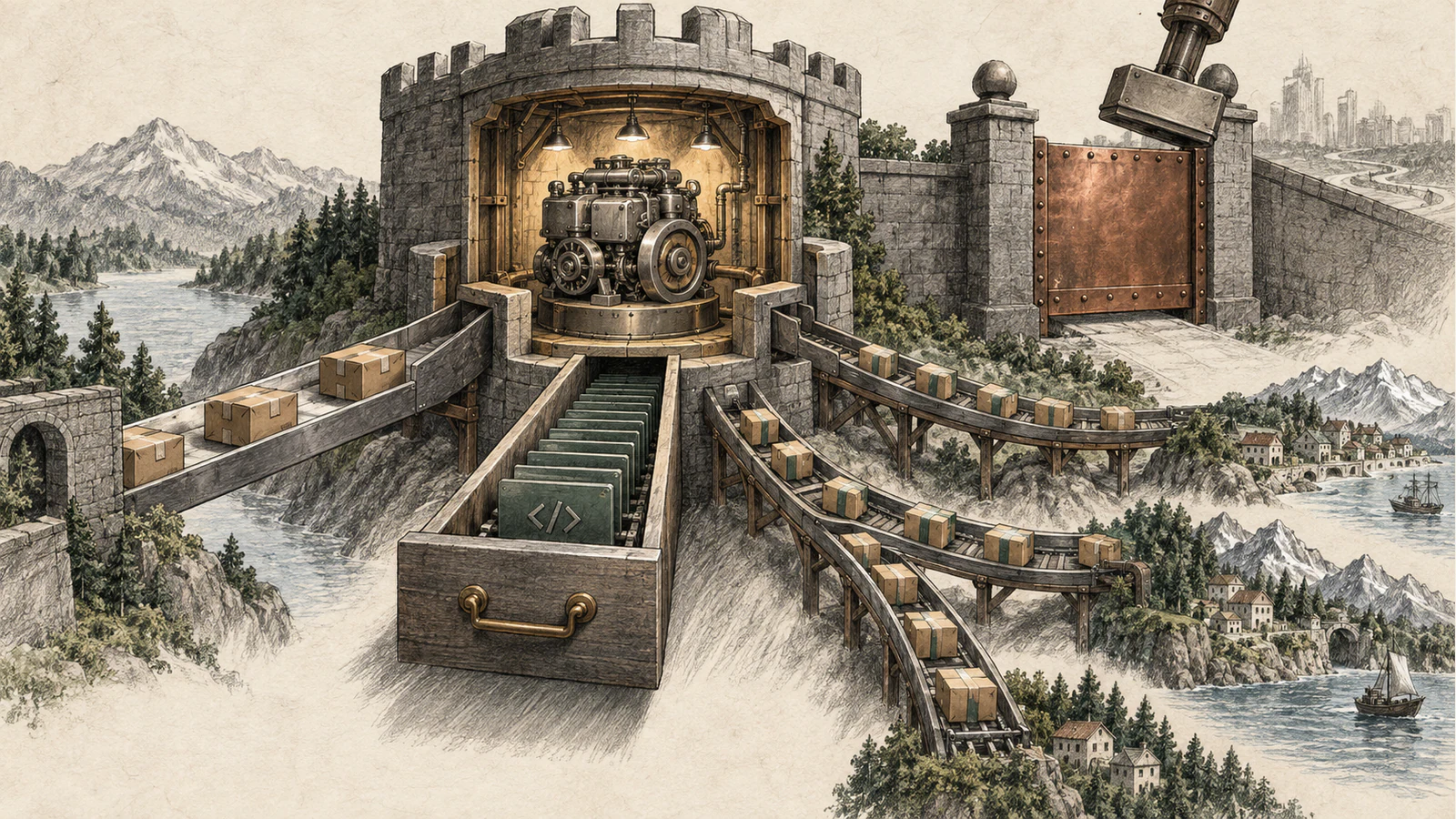
That maps cleanly into rings. The innermost ring is what the project controls outright: the website, the repository, the APK, the content service. The middle ring is independent infrastructure the project neither owns nor depends on a single gatekeeper for: the distribution packagers and BSD ports collections listed on the downloads page. The outer ring is a store listing, useful for reach, unnecessary for survival, and the only ring where someone else’s complaint process can switch the channel off. The reported removal, if accurate, removed one ring. The engine kept distributing.
Why does a delisting still hurt a project that distrusts the store?
Because reach and trust are different axes, and stores concentrate reach. Android is one of Luanti’s five supported platforms (luanti.org), and it is the only one where discovery defaults to a single company’s search box. A phone user who hears about the engine types “Luanti”, or “Minetest”, the project’s name before the rename (Wikipedia), into the Play Store rather than into a browser. If a sanctioned listing disappears while the unofficial builds remain, the trustworthy option vanishes from exactly the place the untrusted ones live, and the knockoffs inherit the search traffic.
There is also a cadence cost. 5.17.0 shipped August 20, 2026; a removal reported on August 29 would mean the newest release was the one users could not reach through the store [unverified]. Release momentum is how open-source projects convert attention into contributors and testers, and a distribution gap at the moment of a release wastes the attention the release itself generated.
None of this makes the store load-bearing in the infrastructure sense. It makes the listing load-bearing in the marketing sense, which is a different and more recoverable failure: a channel that can be re-listed, or worked around with the direct APK plus the website, at the cost of the install base that searches there first. A project that knows which of its channels are infrastructure and which are marketing loses days to a delisting. A project that does not know loses its distribution.
What does 15 years of license provenance buy a maintainer?
Almost everything a maintainer would want to cite in a copyright dispute already exists in Luanti’s public record. The project originated in October 2010 as Minetest, created by Perttu Ahola to explore the mechanics of Minecraft, under GPL-2.0-or-later; it has been LGPL-2.1-or-later since 2013 (Wikipedia). The engine is written in C++ and Lua on Irrlicht-MT, a fork of Irrlicht, and the full history sits in a public repository, versioned under a major.minor.patch scheme (GitHub).
Read that as a paper trail rather than trivia. Origin date, author, initial license, license change with year, continuous commit history, public releases: this is the evidence set a project reaches for when asked to substantiate ownership of its code. Fifteen years of it cannot be assembled after a notice arrives; it can only be preserved. The rename from Minetest to Luanti, a portmanteau of Lua and the Finnish luonti, meaning “creation” (Wikipedia), is on the record too, which matters because a system matching on names or code fragments has no idea the two are the same project, and a maintainer who has documented the rename can rebut that confusion in one paragraph.
The fork is worth pausing on. An engine based on a fork of Irrlicht does not have one clean provenance line; it has a chain, and every link in it (what came from Irrlicht, under what license, when the lines diverged) is something a serious dispute would ask about. That is the normal condition of long-lived open-source engines, and it is precisely why the paperwork matters. “LGPL-2.1-or-later since 2013” is a sentence a human can verify against the repository and its history, not a claim that depends on anyone’s memory of 2013.
How do Google Play, the App Store, and GitHub actually process takedown notices?
The honest answer is that this article’s sourced record does not include the policy text for any of the three platforms, so it will not restate their procedures, requirements, or timelines from memory. That is a deliberate refusal, not an oversight. US copyright law frames these disputes and a counter-notice mechanism exists in statute, but the specifics, what a valid counter-notice must contain, how long a store takes to act on one, and what each platform’s appeal path looks like today, are exactly the details that change between policy revisions and are absent from the sources behind this piece. A step sequence offered without the current published policy pages would be invented, and invented legal procedure is worse than none.
What can be said without those texts is structural, and the structure is the story. A takedown notice is cheap to file and, from an automated service, effectively free at the margin. A response is not: it costs a maintainer an afternoon at minimum, spent reading policy, drafting language, and assembling evidence, during a period when their distribution is switched off. Machine-generated notices multiply that asymmetry. If a store’s intake process runs at machine speed while its appeal process runs at human speed, the store becomes the cheapest place in a project’s distribution chain for a third party to cause an outage, and parties looking for cheap levers will find it.
The second-order effect compounds the first. Every automated notice pipeline that files cheaply and suffers no penalty for being wrong lowers the cost of the next complaint, so the volume trend runs one direction regardless of how any individual store responds. This is the enforcement-side mirror of the AI-detection false-positive problem: systems that flag first and verify never, except that here the false positive arrives with a platform’s enforcement power behind it rather than a moderation label. The reported Luanti case, if accurate, is one instance. The mechanism requires no malice, only cost asymmetry.
The platforms are also not interchangeable in what they hold. GitHub is a code host whose free tier gives access to a vast library of public repositories (Coursera’s overview), and a notice against a repository lands where the project’s own history is the evidence. A store listing is distribution gating: the store decides what ships to the platform’s users, inside a process the maintainer does not administer. Same legal regime, different blast radius.
What should maintainers prepare before a notice lands?
Treat every store listing as one channel, and make sure the channels you control can absorb its loss tomorrow. Luanti’s posture is the template, and each element of it is visible in the project’s own pages.
First-party downloads stay authoritative. The website, not any store, is where official builds for every platform are published, including a direct Android APK (Luanti downloads). A user who never opens an app store can still get the software.
Source sits on infrastructure built for exactly this. The repository carries the history, the releases, and the issue tracker. Public repositories are what GitHub’s free tier provides (Coursera’s overview), so there is no cost argument against it.
Independent distribution rails exist for the platforms that need them. Luanti’s downloads page routes Linux users through Snap, PPAs, Flatpak, and the package managers of the major distributions, and the BSDs through their own ports and package systems (Luanti downloads), so desktop users are not funneled through any single gatekeeper. Content distribution runs through ContentDB, reached from inside the engine, so the game and mod catalog does not depend on any app store either.
Provenance is documented before it is needed: origin, license history, rename, repository, the one-page version of the paper trail above.
And the release cadence keeps moving regardless. 5.17.0 shipped August 20, 2026 on schedule (luanti.org), and the website plus the independent channels carried it whether or not a store listing existed that week. Add one operational habit to the list: someone should be watching the store listing, because a delisting you notice on day one and a delisting you notice three weeks later are different incidents with different recovery costs.
Should you still ship your open-source app to Google Play?
Yes, as a marketing channel with real reach, and not as infrastructure. Android is a first-class platform for Luanti (luanti.org), and a store listing buys what a website cannot: search visibility, one-tap install, automatic updates. The reported removal is not an argument against shipping to stores. It is an argument against depending on them.
The limitation cuts both ways, and it deserves to be stated as sharply as the advice. This article’s evidence base contains one incident, and that incident is unverified in every particular: no sourced page confirms the Tracer AI notice, the removal, the reinstatement, or the Hacker News traction, and no sourced page describes how Google Play, the App Store, or GitHub process notices today. Generalizing from one unverified removal to a claim that stores rubber-stamp AI-generated notices would be exactly the overreach this article exists to avoid. What survives the evidentiary cut is narrower and more useful: the distribution-chain analysis, the provenance playbook, and the documented fact that Luanti itself treated the Play Store as its least trusted channel long before any AI is said to have noticed it.
That narrow version is the one worth acting on. Keep the website authoritative, mirror the source, list the independent channels, write the provenance page, then ship to the store. If a bot files a notice against your listing, you lose a ring, not the chain. Luanti’s own documentation is the evidence that the chain holds.
Frequently Asked Questions
Does the Luanti distribution strategy apply to closed-source mobile apps?
No, because closed-source apps cannot rely on public GitHub repositories or independent content services like ContentDB for distribution. They must maintain private build servers and signed APKs, which increases the operational cost of maintaining redundant channels compared to open-source projects that can mirror source code freely.
How does the Minetest to Luanti rename affect automated copyright detection?
The rename creates a provenance gap that keyword-matching systems may fail to bridge, potentially flagging the project as new or unrelated to its predecessor. Maintainers must explicitly document the name change in their provenance page to help human reviewers distinguish between a new infringement and a legacy project with a history.
What is the primary risk of relying on app stores for open-source discovery?
App stores concentrate search traffic, so if a sanctioned listing is removed, untrusted third-party builds often inherit the search visibility. This shifts users toward unofficial versions that may contain spyware or ads, as warned on Luanti’s downloads page, rather than directing them to the authoritative first-party website.
Why is a one-page provenance document more effective than scattered repository metadata?
A consolidated document allows a maintainer to present origin, license history, and rename details in a single reviewable artifact, reducing the time a reviewer spends verifying claims. Scattered metadata across commits and wiki pages requires manual assembly, which is inefficient during the short window when a distribution channel is offline.


Join the discussion
Share a useful perspective or ask a question about this article.