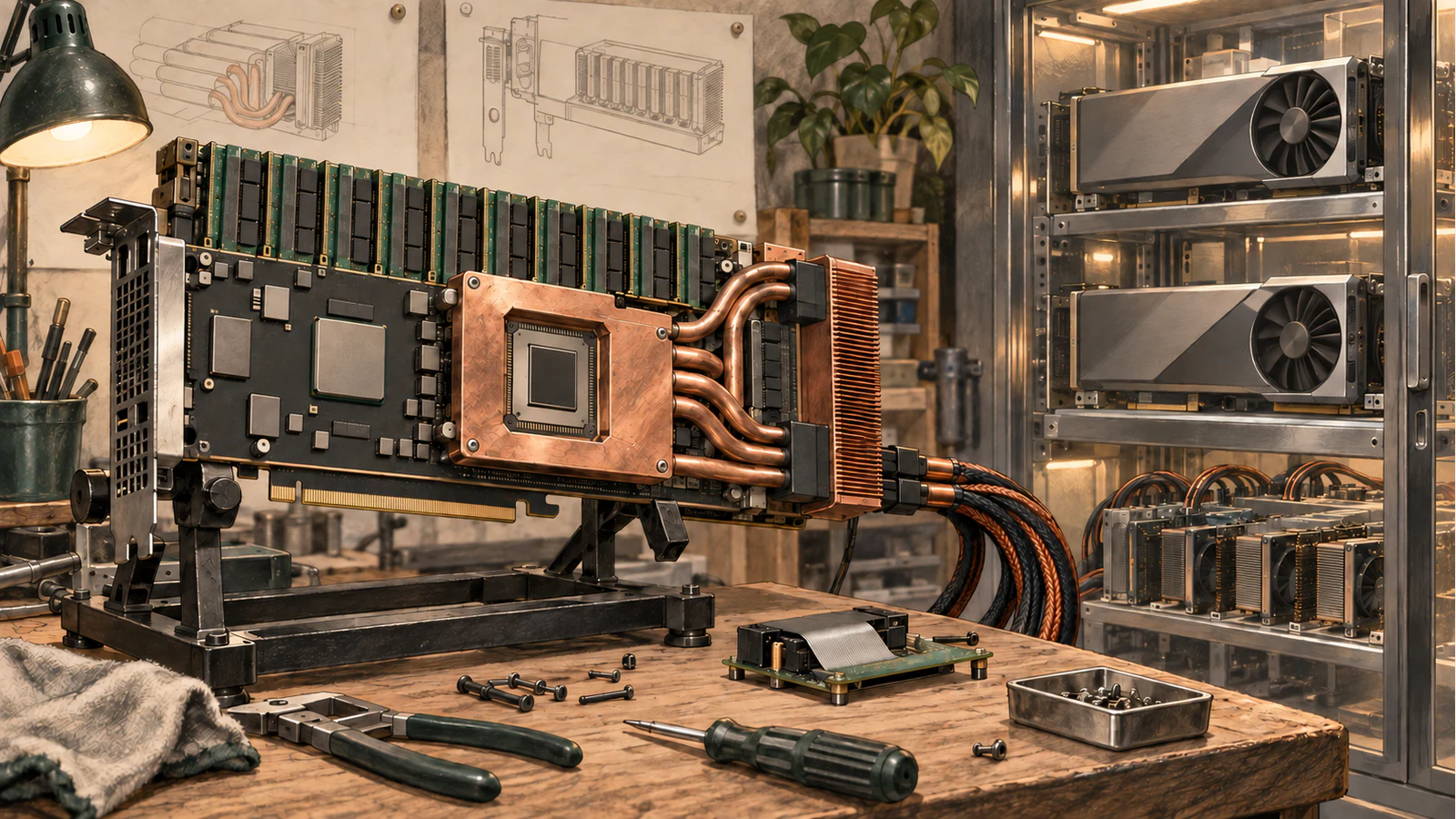
A 16GB GPU for around $60 would reprice local LLM inference for anyone priced out of Apple Silicon. One secondary deal blog puts AMD’s BC-250, a repurposed crypto-era RDNA2 board with 16GB of GDDR6, at exactly that price, and no vendor page corroborates it, so treat it as a lead, not a fact. What is verifiable is the decision it creates: at that price, VRAM stops being the constraint and software support becomes it.
Is the BC-250 really a $60 card?
The $60 BC-250 price is a single-source claim from a secondary deal blog, unverified against any vendor or marketplace page as of 2026-09-06. Nothing in the material we could fetch, AMD’s driver portal, llama.cpp’s official site, or any community thread we pulled, mentions the BC-250, RDNA2 mining derivatives, or a price for one. The card’s identity as a repurposed crypto-era RDNA2 part with 16GB GDDR6 traces to the same single source as the price. Used-market pricing compounds the problem: one blog’s snapshot says nothing about shipping, seller reputation, or what the number becomes once a handful of readers find the same listing.
That matters for how you should read the rest of this article. The hardware column of any BC-250 comparison is inference, not measurement. Nobody in the fetched record has benchmarked the card against a 13B-class model, confirmed its ROCm behavior, or documented its memory bandwidth. If the blog is wrong about the price or the card’s driver behavior, what survives is a generic used-GPU framework, which is still useful, but you should know which layer you’re standing on.
The verifiable layer is the software and capacity side. AMD’s driver portal documents auto-detect driver packages for Radeon graphics on Windows 11 and Windows 10 64-bit version 1809 and later, and Linux channels for Ubuntu, RHEL/CentOS, and SLED/SLES. That list is enterprise-skewed and says nothing about mining boards. llama.cpp claims one optimized binary with hand-tuned kernels across Apple Silicon, NVIDIA RTX 5090 and 3090, AMD Radeon RX and MI300, Intel Arc, Jetson, and B200. “Radeon RX” appearing in that matrix is not evidence that a BC-250 works; it is evidence that the project intends vendor-neutral coverage. That intention is worth something, and it is not the same as a compatibility guarantee for any specific board.
What fits in 16GB of VRAM in 2026?
Sixteen gigabytes confines you to smaller dense models; the current flagship generation does not come close to fitting. Per Ollama’s Llama 4 listing, Llama 4 Scout is a 109B-parameter Mixture-of-Experts model with 17B active parameters, and Llama 4 Maverick is a 400B-parameter MoE with the same 17B active count. At 4-bit quantization, Scout’s weights alone need roughly 55GB, more than three times the BC-250’s entire VRAM. Maverick needs proportionally more. The arithmetic is mechanical: four bits is half a byte per weight, so storage tracks the total parameter count, and the KV cache for a usable context window stacks on top of the weights.
The “17B active parameters” figure is a marketing trap worth naming. Active parameter count describes compute per token, not storage. Every expert’s weights must live in memory for the router to reach them, so a 109B MoE stores like a 109B model even though it computes like a 17B one. A 16GB card is out of the Llama 4 generation entirely, at any price. That is arithmetic, not a driver problem.
What 16GB does buy is the dense tier below the flagships: 13B-class and smaller models at comfortable quantization levels, with room left for a usable context window. That tier is where most r/LocalLLaMA entry builds already live, which is why the used-GPU tiers the community recommends (RTX 3060 12GB, Tesla P40, used 3090) are priced the way they are. The 3060 12GB’s constraint is capacity; the 3090’s is cost. A 16GB card at a genuinely low price would sit between them on capacity and below both on cost, which is the entire appeal of the BC-250 claim.
One more wrinkle from Ollama’s listing: the Llama 4 models are natively multimodal with image input, tested up to five input images. Multimodal encoders add their own memory overhead on top of the language weights, which tightens the 16GB budget further for anyone hoping to run vision-capable models locally. If multimodal inference is your workload, the capacity ceiling arrives sooner than the parameter math alone suggests.
What software actually runs on an AMD card?
The answer that matters is llama.cpp’s backend coverage, and it is vendor-neutral by design rather than AMD-specific by proof. The project’s official site describes a single optimized binary with hand-tuned kernels spanning Apple Silicon, NVIDIA’s RTX line, AMD Radeon RX and MI300, Intel Arc, and Jetson. For an x86 builder, that means the practical path on AMD hardware runs through the Vulkan and ROCm backends, both of which target Radeon RX-class GPUs generically.
Generically is the operative word. The matrix names Radeon RX, not the BC-250, and not any RDNA2 mining derivative. A mining board can differ from its consumer sibling in firmware, display outputs, power delivery, and occasionally in how the driver stack identifies it. None of that is documented for the BC-250 in any source we could verify. The reasonable expectation is that an RDNA2 die behaves like an RDNA2 die once the driver loads, but “reasonable expectation” is doing the work that a tested benchmark would normally do. This is where the article’s honesty budget gets spent: llama.cpp’s vendor-neutrality is the project’s own claim, and Radeon RX support is not the same as BC-250 support.
The driver layer is narrower than NVIDIA buyers are used to. AMD’s portal offers auto-detect packages for Windows 11 and Windows 10 64-bit 1809+, and Linux support aimed at Ubuntu, RHEL/CentOS, and SLED/SLES. If you run Arch, Fedora, or a Debian derivative outside those channels, you are already off the documented path for consumer Radeon, let alone for a mining derivative. AMD listing enterprise distributions on its driver page says nothing about ROCm coverage for any specific GPU; ROCm’s supported-device list is a separate and famously pickier document, and the BC-250 does not appear in anything we could check.
The practical reading: if your stack already lives inside llama.cpp’s portable backends, an AMD card is a first-class citizen and the BC-250’s software story is “probably fine, verify on arrival.” If your workflow depends on CUDA-tier tooling, anything that assumes nvidia-smi exists, the cheap card buys you 16GB of VRAM you cannot easily spend.
Why do practitioners still default to NVIDIA?
Because the ecosystem default is CUDA, and entry-level buyers follow the default even when it costs them VRAM. The clearest evidence in our fetched set is a 2025 Ask HN thread on a light ML laptop for Linux, where the buyer’s stated requirement for local small-LLM inference and image generation is “NVIDIA GeForce w/ ~8GB VRAM.” Not 12GB, not 16GB: 8GB, and specifically NVIDIA. That is the community’s actual entry-tier instinct, and it runs against the cheap-AMD thesis.
The gravity is structural. NVIDIA’s GeForce RTX page states that over 800 games and applications use RTX, with AI features like DLSS Multi Frame Generation layered on top. For inference specifically, the CUDA path is the one every tutorial, every Docker image, and every “works on my machine” answer assumes. When something breaks on a Radeon card, the search results thin out fast. When something breaks on a 3060, the fix is usually the first hit.
The used 3060 and 3090 also carry a quiet advantage that has nothing to do with drivers: they are known quantities. NVIDIA’s current RTX lineup is built on Blackwell with fourth-gen RT cores and fifth-gen Tensor cores, which puts Ampere-era cards multiple generations behind, but “behind” for gaming is not “behind” for inference. A used 3090’s 24GB and mature CUDA support still anchor the serious end of budget local inference, and the community’s institutional knowledge for those cards is deep. The BC-250’s institutional knowledge, as of this writing, is one blog post.
(One research footnote for anyone replicating this: searching “RTX” also surfaces RTX Corporation, the aerospace conglomerate formerly known as Raytheon Technologies, headquartered in Arlington, Virginia. It has nothing to do with NVIDIA’s GPU brand. Disambiguate before you cite.)
How does the BC-250 compare to a used RTX 3060 or 3090?
On the axes that actually decide a budget inference build, the BC-250 wins exactly one (price, if the $60 claim holds) and loses or ties on everything verifiable. The table below separates the measured layer from the inferred one; the AMD column leans on generic vendor documentation rather than BC-250 testing, because that testing does not exist in anything we could fetch.
| Axis | AMD BC-250 (claimed) | Used RTX 3060 12GB | Used RTX 3090 24GB |
|---|---|---|---|
| Secondary price | ~$60 (single-source, unverified) | Known used tier, well above $60 | Highest of the three |
| VRAM | 16GB GDDR6 (single-source) | 12GB | 24GB |
| Fits Llama 4 Scout (109B)? | No; needs ~55GB at 4-bit | No | No |
| Fits 13B-class dense models? | Yes, on capacity | Tight at 12GB with context | Yes, comfortably |
| Inference backend | llama.cpp Vulkan/ROCm; “Radeon RX” listed, BC-250 not named | CUDA, the ecosystem default | CUDA, the ecosystem default |
| Documented driver channels | Windows 11/10 1809+, Ubuntu, RHEL/CentOS, SLED/SLES | Full consumer NVIDIA channels | Full consumer NVIDIA channels |
| Community knowledge base | One secondary blog | Deep; r/LocalLLaMA standard | Deep; budget-workhorse standard |
| Ecosystem breadth | Forgoes the 800+ RTX application layer | Inside it | Inside it |
Read the table as a decision rule, not a scorecard. If your stack is llama.cpp-first and your models fit in 16GB, the BC-250’s row dominates on cost per gigabyte by a wide margin, again, conditional on the price being real. If anything in your workflow touches CUDA-only tooling, the AMD row’s savings evaporate into debugging time. The 3090 row exists for builders who keep outgrowing 16GB; 24GB is the smallest capacity that moves you into a different model class, and no $60 card substitutes for it.
When should you skip the cheap card?
Skip it unless you are already inside llama.cpp’s vendor-neutral world and running dense models that fit in 16GB. That is the whole verdict. The practical evidence is that entry-level practitioners default to NVIDIA at even 8GB, and the reasons are sound: CUDA is where the tooling, the tutorials, and the answered forum questions live. A card that saves you a hundred dollars and costs you a weekend of ROCm archaeology is not cheap.
The honest accounting of this article’s own limits belongs here too. Every load-bearing BC-250 particular, the price, the hardware identity, the ROCm behavior, the memory bandwidth on 13B-class models, comes from one secondary blog and appears in nothing we fetched from AMD, llama.cpp, or the community record. If the blog is wrong, the headline collapses and what remains is a generic used-GPU primer: buy VRAM capacity first, buy into the software ecosystem second, and distrust MoE marketing that quotes active parameters as if storage were free. That primer is still correct, and it still points most x86 builders at the used RTX 3060 12GB as the default entry build, with the 3090 for anyone who knows why they need 24GB.
If the $60 BC-250 is real, and you can verify the specific listing, the driver loads on your distro, and llama.cpp’s Vulkan or ROCm backend sees the card, then it is the rational buy for the 16GB dense-model tier and nothing else. Verification is concrete, not open-ended: install the driver from AMD’s portal, confirm the card enumerates in llama.cpp’s Vulkan or ROCm backend, and run a 13B-class model at the context length you actually use, all inside the seller’s return window. The bottleneck in budget local inference has moved from VRAM capacity to software support, and the BC-250, verified or not, is a clean illustration of that shift. Verify before you buy. The card being cheap is precisely what makes nobody else’s testing available to lean on.
Frequently Asked Questions
Does the 16GB VRAM on the BC-250 support running Llama 4 Scout or Maverick?
No. Llama 4 Scout requires approximately 55GB of VRAM at 4-bit quantization, which exceeds the BC-250’s capacity by a factor of three. The 17B active parameter count refers to compute load per token, not storage requirements, so the full 109B weight matrix must still reside in memory.
How does the BC-250’s driver support compare to standard consumer Radeon cards?
AMD’s official driver portal lists support for Ubuntu, RHEL/CentOS, and SLED/SLES, but does not explicitly document mining derivatives like the BC-250. Users on Arch, Fedora, or other Debian derivatives are outside the documented support channels, requiring manual driver configuration that is not guaranteed to work for repurposed crypto hardware.
What is the primary risk of buying the BC-250 based on the $60 price claim?
The price and hardware identity are single-source claims from a secondary blog, unverified by vendor pages or community benchmarks. If the card fails to enumerate in llama.cpp’s Vulkan or ROCm backend, the buyer loses the return window without a verified fallback, making the low price a potential trap for untested hardware.
Why do practitioners still prefer used NVIDIA cards over the BC-250 for local LLMs?
NVIDIA’s CUDA ecosystem supports over 800 applications and is the default for tutorials and Docker images, reducing debugging time. The BC-250 relies on llama.cpp’s vendor-neutral backends, which lack the institutional knowledge and immediate community support available for standard NVIDIA GPUs like the RTX 3060 or 3090.


Join the discussion
Share a useful perspective or ask a question about this article.