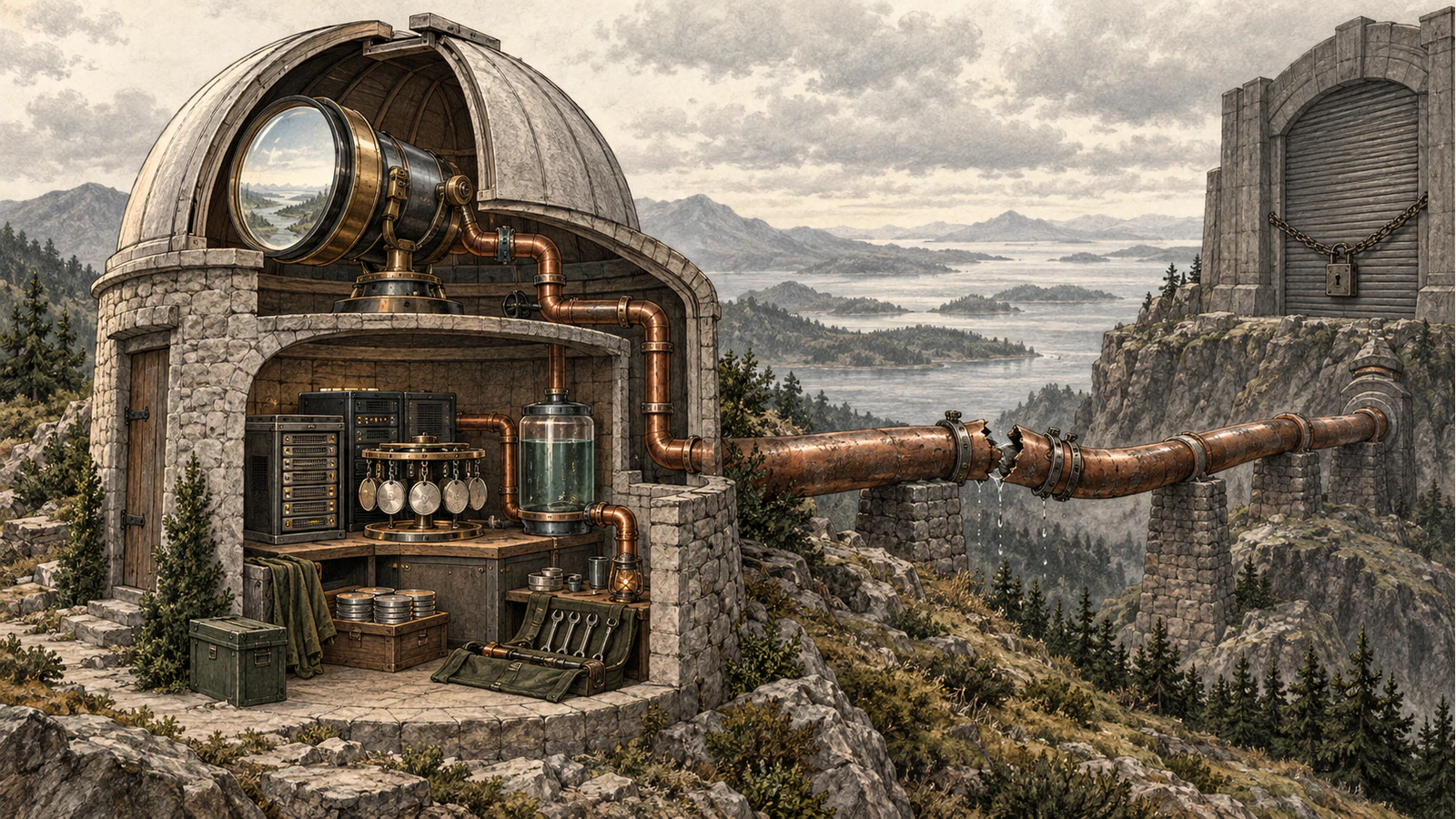
Self-hosting a Nitter instance in September 2026 still works, but the job has changed shape: installation is a one-afternoon task, while staying online is a maintenance contract that now includes supplying X account tokens X can ban and personally absorbing legal exposure X Corp began asserting with cease-and-desist letters on 24 August 2026. The project’s developer halted development after the letters landed; the project’s README now carries an update that it will continue, per the project’s README. Whether to run one now depends less on the initial install than on how much ongoing upkeep, and how much legal attention, you are willing to own.
What actually happened to Nitter in the last two weeks?
On 24 August 2026, X Corp sent cease-and-desist letters demanding the permanent takedown of Nitter instances and the project’s repository. According to the Nitter Wikipedia article, the developer is seeking legal advice and stated that “development has stopped for the time being,” and the XCancel instance announced it was offline “until further notice.” Then the project’s README was updated with a short reversal: “Following legal advice, the Nitter project will continue. More details will be announced soon,” per the zedeus/nitter repository.
“More details will be announced soon” is the entire substance of the announcement. What continuation means in practice, whether normal development resumes or something narrower, is a detail the announcement does not cover. Anyone planning infrastructure around Nitter should treat the continuation as a stated intent, not a shipped fact, and re-check the project’s announcement channel before committing.
The timing pattern matters for how much confidence to place in any of this. Nitter was discontinued in February 2024, and development resumed on 6 February 2025, per Wikipedia’s Nitter history. The August 2026 cease-and-desist followed by a “we continue” statement is the second death-and-revival cycle in under three years. A service that has been declared dead twice is not dead, but it is also not a stable dependency.
How does Nitter fetch X content in 2026?
Nitter now works by authenticating with registered X account tokens, because the guest-account mechanism that powered it for years was removed by X in January 2024. Per Wikipedia, Nitter originally relied on a glitch that allowed the mass creation of “guest accounts” through proxy servers, letting instances serve content without any real X account behind them. When X removed guest-account creation and heavily restricted logged-out access, that model ended, and the revived project shifted to tokens from registered accounts.
The consequence for an operator is direct: the account behind your instance is a real X account, and X can ban it. When the project was declared dead in February 2024, Zedeus said instances could be self-hosted by having users supply their own account “at the risk of the account being banned,” according to Wikipedia. That risk has not gone away; it has moved from an abstract warning to the core operating mechanism. Every request your instance serves is authenticated as some account, and that account is a finite resource with a target painted on it.
This is the single most important architectural fact for anyone evaluating self-hosting today, and it is also the one most likely to be missed, because public instances still carry stale copy. The nitter.ca instance, running commit 13a4580, still displays pre-2024 text claiming the unofficial API has “no rate limits or developer account required,” per its about page. That description was accurate under the guest-account regime. It is not accurate now. If you are evaluating Nitter by reading instance about-pages, you are reading documentation for a system that no longer exists.
What does the setup actually involve?
The stack is small: per the project README, the dependencies are libpcre, libsass, and redis/valkey, with Redis required for caching. To compile Nitter you need a Nim installation, and to compile the scss files you need libsass. A reverse proxy sits in front. None of this is exotic; it is a standard small-service stack. The Nim dependency is the only unusual piece.
So the honest answer to “how hard is it to install Nitter” is: an afternoon, including reading the config options. That answer is also nearly useless, because installation is not where the cost lives.
What does running it cost you every week?
Running a Nitter instance costs you continuous token maintenance and upstream commit tracking, indefinitely. Together, those are the actual price of the service.
Token maintenance is the recurring one. Your instance authenticates through registered X accounts, and X can ban them. The February 2024 guidance from Zedeus that users supply accounts “at the risk of the account being banned,” recorded by Wikipedia, describes a routine operational event, not an edge case. When a token dies, you replace it and restart. When X decides to crack down harder, several die at once. The practical mitigation is the obvious one: use disposable accounts created for this purpose, never an account you care about, and never a paying one. Run it on disposable accounts and keep the instance private.
Commit tracking is the second treadmill. Nitter scrapes X’s frontend, which means every time X changes that frontend, Nitter can break until a patch lands. The last tagged release listed on Wikipedia is 2026.03.15-7ce29bd, dated 15 March 2026, which predates the August cease-and-desist by five months. An operator is therefore not tracking releases; they are tracking commits on a repository whose continuation plan is a single sentence. The correct posture is to pin a working commit, watch the upstream channel, and re-pull when X moves something. If the continuation stalls, you are the maintainer.
The table below prices the decision axes as they stand in September 2026, based on the repository documentation and Wikipedia’s account of the mechanism change:
| Decision axis | What you get | What you carry |
|---|---|---|
| Auth mechanism | Registered account tokens | Accounts X can ban; rotation is your job |
| Deployment | Nim build with libpcre and libsass | A compile toolchain to maintain |
| State store | Redis or Valkey, required for caching | Another service to run and back up |
| Maintenance | Upstream fixes when X’s frontend moves | Tracking commits on a repo whose continuation plan is one sentence |
| Features | Read-only timelines, search, chronological order | No login, posting, notifications; RSS often disabled |
| Legal | AGPLv3 code, community instances | Personal exposure to X Corp’s active C&D campaign |
Is this a setup problem or a maintenance problem?
It is a maintenance problem, and Nitter is a clean example of a general pattern: self-hosted services that are marketed, or remembered, as easy to install while being expensive to keep. The install here is a short dependency list and a Nim build. The maintenance is an open-ended commitment to rotate banned tokens, chase upstream commits whenever X changes its frontend, and monitor a legal situation that produced a cease-and-desist two weeks ago.
The setup-versus-maintenance asymmetry generalizes past Nitter. Most self-hosted software sold as “easy” is easy at hour one and priced at hour one thousand. The honest cost model for a scraping proxy specifically has three line items that setup guides omit: the consumable resource (here, X accounts with finite lifespans), the adversarial dependency (a platform that actively changes to break you), and the legal surface (an entity that has now demonstrated, on 24 August 2026, that it will send letters). A service with all three is not a weekend project; it is an operations role with no salary.
This is also why the performance pitch, while real as far as it goes, should not drive the decision. The project reports that for the @nim_lang account, Nitter serves 60KB versus 784KB from twitter.com, is on average around 15x lighter, and loads timelines two to four times faster, per the README. Those are self-reported figures with no independent verification in the sources reviewed, and they describe the reader’s experience, not the operator’s costs. A 15x lighter page is a reason to use Nitter. It is not a reason to run Nitter.
What legal exposure does an operator carry now?
An operator now carries personal exposure to an active X Corp cease-and-desist campaign that began on 24 August 2026 and is, as of this writing, unresolved. The letters demanded the permanent takedown of Nitter instances and the project repository, per the project README. The project’s response is that it “will continue” following legal advice, with details pending. What that means for an individual running an instance from their own hardware is not yet defined, because the project’s own legal posture is not yet defined.
The license side is clearer. Nitter is AGPLv3 with no proprietary instances permitted, per the README. The AGPL means that if you modify the code and serve it publicly, you owe source. That does not protect you from a C&D; it just defines the compliance floor.
The practical read: X Corp has shown it will send letters, the letters stopped development on the project for a time, and the continuation plan is a one-sentence announcement. An operator who keeps an instance private and small is a different target than a public instance listed on a tracker, but “different target” is a risk judgment you are making alone. No legal defense fund or backing company is named in any of the sources. Wikipedia records a past grant from the NLnet Foundation’s NGI fund, but that is historical project funding, not legal backing for the current dispute. The “you” in “self-hosted” is doing real work in the legal section.
Should you self-host Nitter right now?
Self-hosting Nitter in September 2026 is viable for a reader who will run it privately, on disposable accounts, and treat it as a maintained system rather than an installed one, and not viable for anyone who needs it to be a stable dependency. The mechanism works: registered-account tokens, a Redis or Valkey cache, read-only browsing and search behind your own reverse proxy. The costs are concrete: token rotation when bans land, commit tracking on a repository whose future was announced but not detailed, and personal legal exposure during an active enforcement campaign whose endgame is unknown.
Two checks before investing any time. First, re-read the project’s announcement channel; the continuation statement promises details, and those details determine whether you are tracking a living repo or inheriting a codebase. Second, if the instance-count observation that motivated this piece matters to your decision, verify it against a live tracker such as the status page linked from Wikipedia’s Nitter article, since it does not appear in the primary documentation.
The limitation to keep in view is that nearly everything here comes from project-side sources: the README, Wikipedia’s summary of it, and one live instance’s about-page. There is no X Corp statement beyond the reported cease-and-desist actions, no verified instance count, and no X API pricing in the reviewed sources to ground a cost comparison against simply paying X. The claim that Nitter access beats the paid API on economics is plausible, given that X’s official pitch is a free app plus an X Premium subscription marketed around a blue checkmark, expanded reach, and revenue sharing, per X’s own help pages, none of which a read-only proxy user wants. But “plausible” is where the evidence stops. Run it if the maintenance contract reads like work you will actually do; skip it if you were hoping the Docker command was the whole job.
Frequently Asked Questions
What specific Docker error occurs if the sessions.jsonl file is missing?
If the mounted config file does not exist, Docker silently creates a directory in its place, causing the container to fail with a ‘not a directory’ error. This is a documented failure mode that requires creating an empty file on the host before starting the container.
Why is Valkey recommended over Redis for Nitter deployments?
Valkey is recommended because Redis stopped being open source in 2024. Since Nitter is licensed under AGPLv3, using a non-open-source dependency like the current Redis version creates a licensing conflict that Valkey, an open fork, avoids.
How does the legal exposure of a private instance differ from a public one?
While the body notes that a private instance is a ‘different target,’ the research brief highlights that no legal defense fund or backing company is named in the sources. This means an operator of a private instance has no institutional shield and must personally absorb any legal costs, unlike a project backed by a foundation.
What is the primary debugging limitation for Nitter operators?
Nitter has no real logging implemented; errors print only to stdout. Operators must inspect logs via journalctl or docker logs, which limits the ability to diagnose intermittent scraping failures or token rotation issues without active monitoring.


Join the discussion
Share a useful perspective or ask a question about this article.