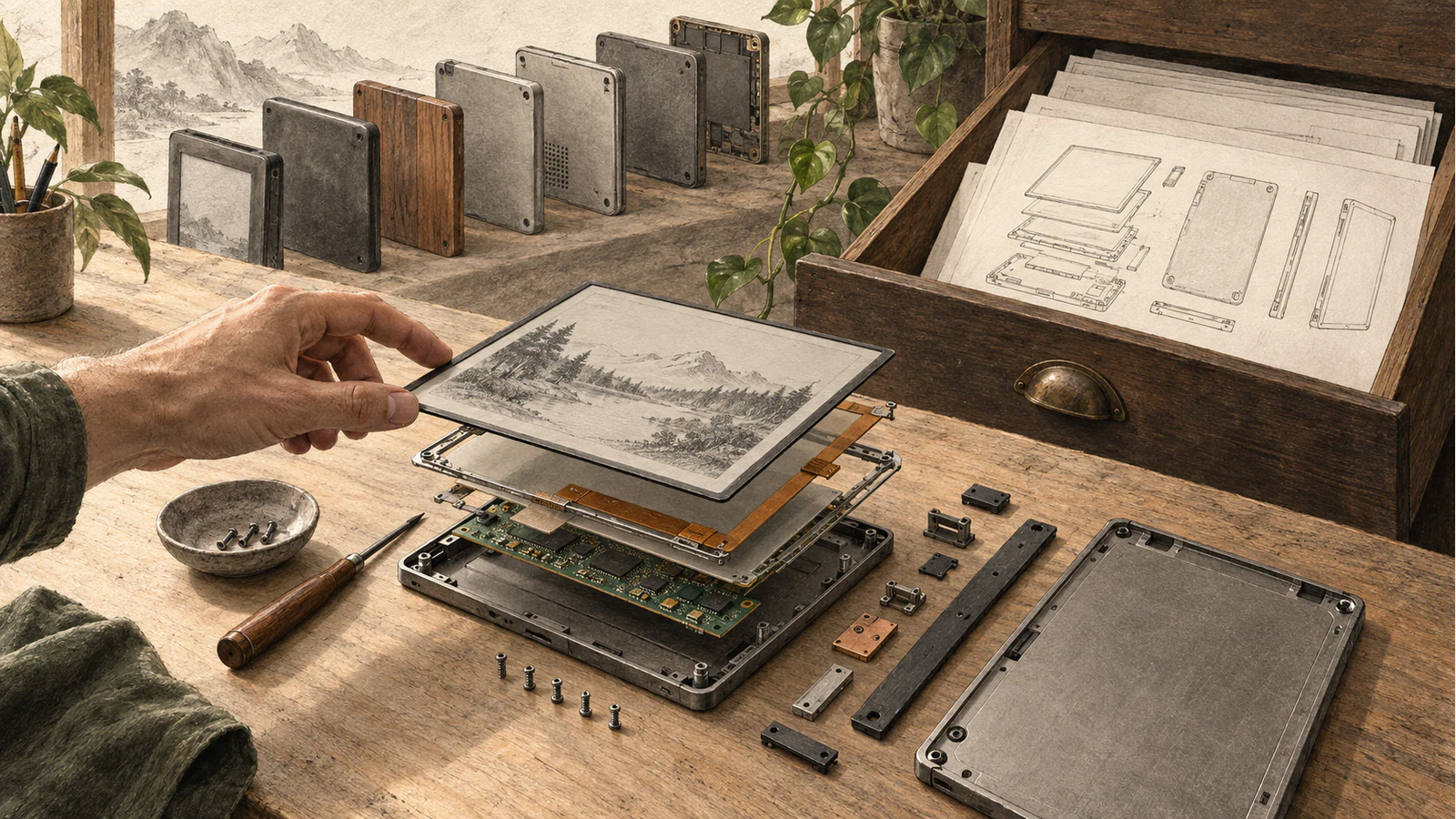
Valve has published the complete design files, firmware, bill of materials, and assembly instructions for the Steam Machine’s Inkterface e-ink front panel under an MIT license on GitLab. The July 2026 release lets owners fabricate and modify the panel themselves, and it extends a years-long run of open hardware drops that already covers Steam Deck CAD files and controller designs.
How long has Valve been open-sourcing its hardware?
Valve’s open-hardware habit predates the Inkterface by several product cycles, and the new release continues a pattern the company has run across the Steam Deck, the Steam Controller, and its VR tracking system.
The Inkterface drop reads best as the next entry in a track record rather than a one-off gesture. The Steam Deck’s CAD files and the Steam Controller’s hardware designs were published under similarly permissive terms, according to prior coverage of the company’s hardware posture, and Valve opened its Lighthouse VR tracking system to third-party hardware years ago. In each case the effect was the same: hobbyists and small manufacturers could build, repair, and modify hardware around the Steam platform without reverse-engineering a shipped unit.
That posture is what to watch, not any single accessory. Each release lowers the engineering cost of community hardware tied to Steam. A modder who wants a custom Deck shell, a replacement stick, or now an e-ink faceplate can work from official geometry and firmware rather than measuring a finished product and guessing at tolerances. The cumulative effect is a platform that grows more moddable with every drop, which is exactly the axis on which it diverges from the major consoles.
The contrast is structural. Sony, Microsoft, and Nintendo ship sealed boxes built around proprietary fasteners, paired components, and firmware that resists modification. Valve ships similar hardware and then hands you the source files. Whether that is generosity or strategy matters less than the outcome: the Steam ecosystem accumulates third-party hardware that the consoles’ ecosystems structurally cannot.
What’s in the Inkterface, and what does building one actually take?
Valve’s bill of materials is short and entirely off-the-shelf, and that is the point: the panel is reproducible by anyone with a soldering iron and a parts order rather than access to custom components.
The published BOM runs to an Adafruit ESP32 Feather with 2 MB of PSRAM, an Adafruit eInk Breakout Friend, a 5.83-inch monochrome eInk panel, thirteen M2.5 × 5 mm pan-head machine screws, and four SB443-OUT stepped magnets (1/4 × 1/4 × 3/16 inch). The design files, firmware, and assembly instructions ship alongside it under MIT, a license permissive enough to permit commercial derivatives rather than personal builds alone.
The separate eInk Breakout Friend is a telling detail. A breakout board exists to drive a raw e-ink panel that lacks its own integrated controller, as opposed to a panel that ships with driver circuitry on board. Valve’s design drives the bare panel through that external breakout, which keeps the driver logic visible and editable in the firmware rather than sealed inside a closed display module. For a panel whose entire purpose is to be modified, that is a deliberate-looking choice.
Two further details separate this from a routine Valve hardware release. The companion application that drives the panel must currently be compiled manually as an AppImage, with an official Steam application planned but not yet shipping. Anyone building a panel today is effectively beta-testing the software stack, not just assembling hardware. Valve also credited contract engineer Kyle Wright as Inkterface’s author. Attribution at that level of specificity is unusual for the company, and it reads less like corporate branding than like the credit you give an outside consultant who delivered working hardware.
Build it yourself, or wait for JSAUX’s version?
Owners who would rather not source parts and solder can skip the DIY route: JSAUX has confirmed a commercial Inkterface variant scheduled to launch later in 2026.
JSAUX’s involvement is what turns the open-source release into a product pipeline rather than a hobbyist exercise. The company is an established Steam Deck accessory maker, so a JSAUX-built Inkterface would cut the barrier from “order five parts and flash firmware” to “buy a finished panel.” The MIT license is what makes that path legal. Valve did not merely publish reference files; it cleared the rights for a third party to manufacture and sell the result.
The DIY-versus-commercial split is worth taking at face value rather than as a hierarchy. The MIT release serves both audiences at once: it gives manufacturers like JSAUX a legal baseline to build a product, and it gives individual owners the option to build their own rather than wait. A closed-source panel would force everyone onto the commercial path. Valve’s choice is to leave both open.
What does the release enable for community hardware builders?
The Inkterface is not the only Steam Machine e-ink panel design in the wild, and the fact that a community alternative already exists is itself the signal.
OpenDisplay/front-panel is a separate, community-maintained project that publishes mechanical build specifications for Steam Machine e-ink panels using Seeed Studio displays and drivers, with designs for both 5.83-inch and 4.2-inch modules. It is distinct from Valve’s official Inkterface: different components, different display vendor, different origin.
| Valve Inkterface (official) | OpenDisplay/front-panel (community) | |
|---|---|---|
| Display | Adafruit 5.83” monochrome eInk | Seeed Studio 5.83” or 4.2” |
| Driver | Adafruit eInk Breakout Friend (external) | Seeed Studio drivers |
| License | MIT | Community project |
| Provenance | Valve / Kyle Wright | Community-maintained |
What the coexistence shows is that the Steam Machine’s hardware interface was already a target for third-party design before Valve’s release, and the official drop does not so much open that door as legitimize it. When the platform owner publishes its own reference design under MIT, it does two things: it hands builders a known-good baseline, and it signals that the interface is fair game to build against. The community project and the official project can coexist precisely because the MIT license does not demand exclusivity.
This is where the “infrastructure, not accessory” framing earns its place. A single e-ink faceplate is a novelty. A platform where the owner publishes the geometry, the firmware, and the parts list for a peripheral while a third party is already shipping an alternative design is the shape of a moddable ecosystem. Each drop compounds on the last, and each one lowers the activation energy for the next builder.
Is moddability becoming a competitive axis in gaming hardware?
Valve’s open-hardware releases are turning repairability and moddability from a compliance checkbox into a feature that separates Steam-adjacent hardware from locked-down consoles.
The mechanism is simple enough to state plainly. Closed consoles compete on exclusive software and subsidized hardware; the business model depends on the customer buying a sealed unit and staying inside the walled garden. Valve’s model runs the opposite way. It earns on software sales through Steam, so it has no structural incentive to stop anyone from modifying, repairing, or replacing the hardware. Every barrier it removes is a barrier its console competitors are commercially obligated to keep.
That asymmetry is visible in the evidence the brief already assembles. Open CAD files, open controller designs, MIT-licensed peripheral firmware, and now an e-ink panel with a published BOM and a named author. None of these is a grand gesture in isolation. Taken together they describe a company that treats its hardware as a platform to extend rather than a product to defend.
The second-order consequence is the one worth tracking. As Valve keeps releasing design files, the cost of building Steam-ecosystem hardware falls, and the cost of building equivalent hardware for a locked-down console does not. Across enough cycles, that gap becomes a reason to pick one platform over another, not for its game library but for what you are allowed to do with the box after you buy it. Moddability becomes a competitive axis because Valve has decided to invest in making it one, not because the market demanded it first.
That is the pattern the title names. The Inkterface is a small release. The posture it continues is the story.
Frequently Asked Questions
Does the MIT release include the PC software needed to drive the panel, or only the hardware design?
It includes the hardware CAD files, firmware, and assembly guide, but the PC-side companion app is not a finished Steam download. As of the July 2026 drop, owners must compile it manually as an AppImage, which means a Linux build environment and some command-line work are currently required until Valve releases an official Steam application.
How is Valve’s Inkterface different from the OpenDisplay/front-panel project?
Valve’s design is the official drop, is MIT-licensed, and uses Adafruit’s 5.83-inch monochrome panel with an external eInk Breakout Friend. OpenDisplay is a community effort built around Seeed Studio displays and drivers, and it supports both 5.83-inch and 4.2-inch modules, giving builders a smaller-size option with a different parts ecosystem.
What tooling and skills does building one from Valve’s files actually require?
Beyond ordering the listed Adafruit parts, a builder needs a soldering iron for the Feather and breakout wiring, a way to fabricate the mechanical faceplate such as a 3D printer or laser cutter, and a Linux machine to build the companion AppImage. The four SB443-OUT magnets also have to be oriented correctly so the panel mates with the Steam Machine’s front.
What are the practical limits of using an e-ink panel for a console faceplate?
The 5.83-inch monochrome e-ink panel refreshes slowly and cannot show color or smooth animation, so it works best for static artwork, status text, or low-update labels. Cold temperatures can also slow e-ink response further, and a custom image that looks fine on an LCD will not translate one-to-one without dithering or grayscale conversion.
What could push Valve to tighten control instead of releasing more open hardware?
If low-quality third-party clones create a support burden or confuse buyers about what Valve officially endorses, the company could pull back even though the MIT license itself cannot be revoked. A successful JSAUX commercial version might also reduce the number of owners building from source, which would lower community contributions back to the firmware.

Join the discussion
Share a useful perspective or ask a question about this article.